Fish and seafood can be considered among the most sensitive food products from the perspectives of packaging, storage, and transportation. High moisture content, reactions with oxygen, temperature fluctuations, specific odors, and the relatively short shelf life of fresh products dictate conditions under which packaging in the fish industry must fulfill far more functions than simply providing protection during transport.
Improperly selected packaging can affect product quality, increase losses in the supply chain, and cause problems on packaging lines. When considering packaging solutions for fish, the most important question should be: What challenges related to the product, the packaging process, and the supply chain should the packaging address?
Why is packaging fish products more complex?
When packaging fish, it is also necessary to control factors such as protection against changes in oxygen and moisture levels, package integrity, protection of the product from external odors, and resistance to mechanical stress. Since the range of fish products and seafood is extremely broad, different barrier properties may be important for each one, so a universal packaging solution for the fish industry practically does not exist. The specifications of different packaging solutions should be tailored to the specific product, such as fresh, smoked, or frozen fish or seafood.
Below are some of the most important factors that influence not only the choice of packaging solution but also the final product quality, which determines your reputation as a manufacturer within the supply chain.
Oxygen—One of the Most Important Factors Determining Product Quality
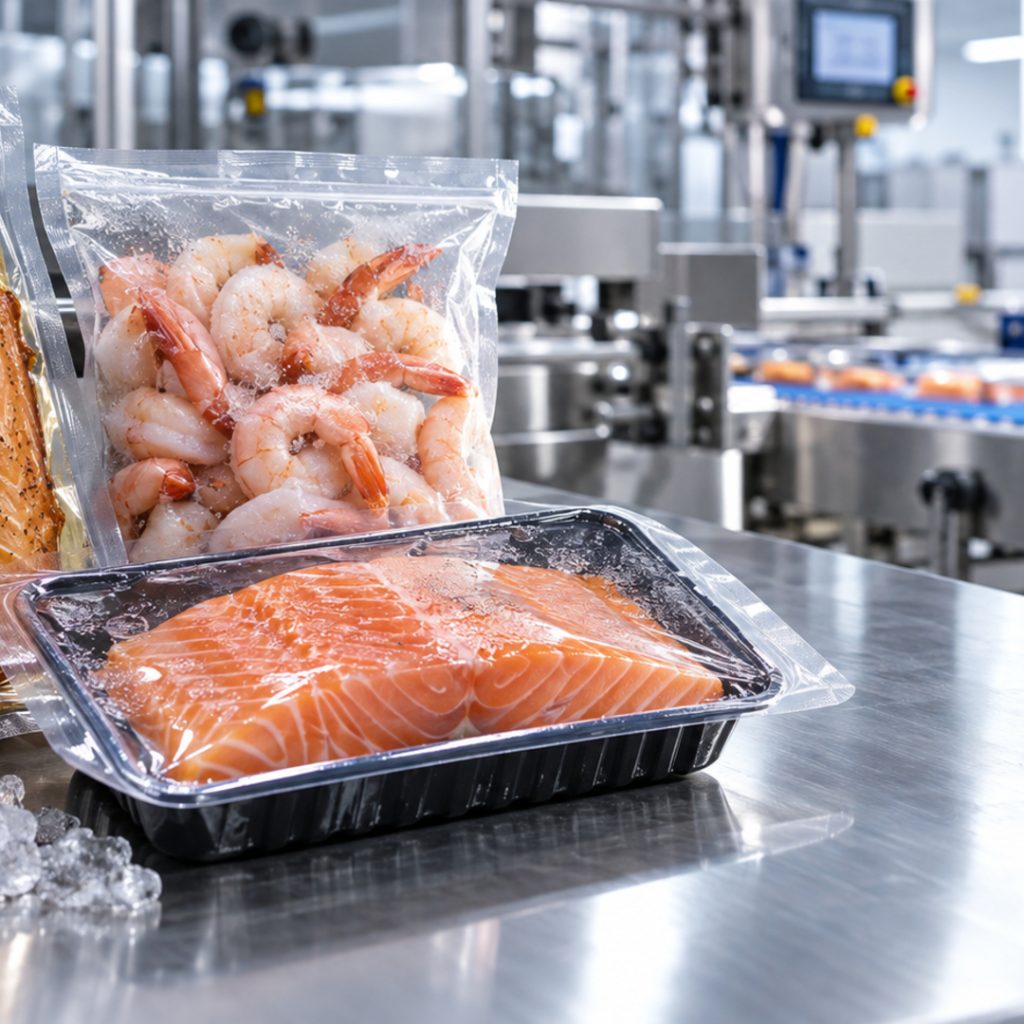
Note: The images used in this article are for illustrative purposes only
When packaging fish, oxygen becomes one of the most critical factors. It can accelerate fat oxidation and affect the product’s sensory properties, so an adequate oxygen barrier is essential for fatty, smoked, and long-life fish products.
It is important to understand that not all fish products require the same type of high-barrier industrial packaging; therefore, when selecting packaging solutions, the following options can be considered:
- For smoked or frozen fish, multi-layer film vacuum bags with a PA/PE barrier layer or structured bags with an EVOH barrier layer that provide a sufficient gas barrier can be selected.
- For fresh fish or fillets, modified atmosphere packaging (MAP) is typically used, which helps maintain a gas atmosphere tailored to the specific product. In this packaging solution, not only the film barrier, seam integrity, and control of the packaging technology itself are particularly important.
- For fish products packaged on standard automated lines, laminated films may be suitable, as their structure can be tailored to the requirements of the product and the packaging process.
Therefore, if you are a B2B representative, before selecting packaging for the fish industry, you must ask your partner: What level of oxygen and other gas barrier is required for a specific product throughout its entire supply chain?
Moisture and Liquids: Not Only the Type of Film Matters, but Also the Sealing
Fish products and seafood naturally contain more moisture, and some products release liquids even during storage. This issue is particularly relevant in automated production. If the product or its liquids were to enter the sealing zone, it would compromise the quality of the seal. Here are some examples of where appropriate sealing solutions may be relevant:
- For portioned fish, fillets, and smoked products, vacuum or laminated bags can be used, depending on whether the structure of the latter is suitable for the selected packaging process.
- For automated production lines, it would be most efficient to choose laminated film, after first adjusting its parameters to match the specific equipment.
- For frozen products, resistance to moisture loss is an additional consideration. The packaging must help protect the fish from dehydration during long-term cold storage.
Non-standard shapes of fish and seafood—a higher risk of punctures
Non-standard shapes of fish and seafood present mechanical challenges not faced by businesses packaging uniformly shaped food products. Bones, fins, shells from shrimp or other seafood, and sharp edges on the product can create an extremely high load on a very small area of the packaging. This factor dictates the choice of the packaging film’s mechanical properties rather than its thickness.
Frozen fish requires packaging specifically adapted to its supply chain
Packaging for frozen fish serves a different purpose than that intended for fresh products. The main objectives of industrial packaging for such fish are to maintain integrity at low temperatures, protect the product during storage and transport, and help limit moisture loss. Over time, moisture loss can lead to dehydration of the fish, which alters the product’s surface, texture, and quality characteristics. What types of packaging can help address these challenges?
- For individually or in smaller portions frozen fish, vacuum bags and other bags designed for freezing can be considered, depending on their characteristics.
- Special frozen fish packaging straps can be used for industrial packaging of frozen fish on ships.
- For blocks of frozen fish (formed fish products, frozen fillets) without outer packaging, separator sheets may also be useful to facilitate the separation and handling of the products.
- For frozen seafood, you can choose specially designed packaging bags that can be selected not only based on the desired thickness and mechanical properties but also on the aesthetic requirements of the packaging.
How important is the film structure in fish industry packaging?
Packaging used for fish products often consists not of a single material but of several materials or layers, each selected to perform a specific function. For example, fish packaging may use LDPE/LDPE, PET/LDPE, OPP/LDPE, PA/PE, or PA/EVOH/PE structures, among others. Each of these layers can enhance the fish packaging’s seal integrity, mechanical strength, oxygen barrier, or print quality.
For vacuum packaging, PA/PE or structures containing EVOH—which provide a higher barrier—may be selected. Laminated fish packaging bags often use LDPE/LDPE, PET/LDPE, OPP/LDPE, and other combinations, and for automated packaging, the structure must be tailored not only to the product but also to the equipment used.
Fish Industry Packaging: Vacuum or MAP—Which Solution Is Best?
Vacuum and modified atmosphere packaging (MAP) address a similar problem, but in different ways.
During vacuum packaging, air is removed from the package and it is sealed tightly. This method may be suitable for smoked, frozen fish, and other fish products. For this packaging option, multilayer vacuum bags made of PA/PE, PA/EVOH/PE, or packages with various laminated structures can be used.
In MAP (Modified Atmosphere Packaging), the air is replaced with a gas atmosphere tailored to the specific product. This packaging solution may be suitable for fresh fish fillets and other products where it is particularly important to control the atmosphere inside the package.
It is also important to consider food safety. Even when simply reducing the oxygen content or changing the gas atmosphere inside the packaging, the packaging itself must also be evaluated in terms of proper temperature control and the technological process as a whole.
How to Choose Packaging for the Fish Industry?
Before contacting a packaging manufacturer, it’s helpful to prepare more than just the desired dimensions of the bag or film. It’s extremely important to gather as much information as possible about the product itself:
- what product will be packaged;
- whether it is fresh, smoked, salted, or frozen;
- whether vacuum, MAP, or conventional packaging is used;
- what packaging equipment is used;
- what the product’s storage temperature is;
- how long the product must remain fit for consumption;
- what mechanical stresses are anticipated during logistics;
- whether printing is required;
- what the company’s goals are regarding processing and reducing packaging weight.
By providing the information listed above to the packaging manufacturer, you can be sure that the selected solution best meets your expectations and the standards that define high product quality.
Below is a table featuring fish industry packaging available on Umaras.eu, along with their intended purposes and practical applications. This table can help you assess the packaging options and requirements for your products.
Table No. 1: “Packaging Solutions for the Fish Industry and Their Practical Applications.”
| Packaging Solution | What Is It Best Suited For? | Main Purpose / Advantage | When Should You Choose a Different Solution? |
| Laminated Bags | Fresh, smoked, and salted fish, fillets, and portioned fish products | Can be adapted for vacuum and MAP packaging when appropriate barrier properties and a reliable seal are required | When the product is packaged on a high-throughput automated line and it is more efficient to use roll stock, or when a specialized solution is needed for frozen fish blocks |
| Laminated Strips | Fish fillets, portioned products, smoked fish, and other processed fish products | Suitable for automated packaging, including Flowpack-type lines; The film structure can be selected based on the required properties | When the production process requires pre-formed pouches, or when the product’s shape and mechanical properties call for a different format |
| Two-color strips | For products where visual distinctiveness and in-store presentation are important | Allows for combining functional packaging properties with a more distinctive product presentation | When the appearance of the packaging is not a priority and the most important criterion is simpler industrial packaging |
| Strips for frozen fish | For frozen fish and products that will be stored and transported at low temperatures | Adapted to frozen product packaging processes and the supply chain | For fresh products where MAP or vacuum packaging and specific gas barrier properties are more important, you should consider another option |
| Sheets for frozen fish blocks | For industrially frozen fish blocks | Helps separate fish blocks, reduce sticking, and facilitate further handling | Not suitable as standalone final retail packaging—their purpose is a specific part of the production and logistics process |
| Bags for seafood | For shrimp, shellfish, and other frozen or chilled seafood | The packaging format can be adapted for packaging and freezing seafood | When the product requires a different packaging method—such as a specific MAP system—or roll stock for an automated line |
The following 7 questions can also help you make the final decision on the most suitable packaging for the fish industry. It’s worth clarifying:
- What barrier properties are required specifically for our product?
- Is the packaging suitable for the intended storage and freezing temperatures?
- Is its mechanical strength sufficient for the specific fish or seafood?
- Will the material perform reliably on our existing packaging line?
- Is it possible to reduce the film thickness without compromising functional properties?
- What options are available to improve the recyclability of the packaging?
- What tests should be conducted before switching to a new specification?
These questions will help you assess the packaging manufacturer’s expertise and better categorize your product packaging needs—which encompass not only the packaging itself and its mechanical strength but also the entire process from packaging to transportation to your partners.
Packaging in the seafood industry—a component that can significantly influence the final presentation and quality of the product
Local Baltic Sea fishing businesses, in order to compete with larger players in this sector, understand that it is not only the quality of the product itself, production efficiency, logistics, and sustainability issues that matter—areas in which industrial packaging plays one of the most prominent roles.
The challenges facing packaging in the fish industry include protecting products from environmental influences, maintaining the necessary mechanical and barrier properties throughout the supply chain, and functioning as a reliable component of the packaging equipment.
For several decades, UMARAS has been providing a variety of packaging solutions for the fish industry, with specifications that can be customized to suit your products and the needs of your production process. Do you have additional questions about packaging or would you like to consult with us? Contact our professionals at Umaras.eu using the contact information provided today!