Barrier packaging in the food industry serves far more purposes than simply protecting meat, fish, seafood, cheese, or other sensitive products during transport. Two particularly important factors in the packaging of these products are oxygen and moisture. Their levels inside the package can affect the product’s oxidation, aroma, color, texture, and, of course, the preservation of its quality. When selecting packaging, it is indeed important to evaluate not only its thickness or mechanical strength but also its barrier properties. In this article, we will share useful information about oxygen and moisture control that every food industry owner or business representative should know.
What is barrier packaging?
Barrier packaging is a packaging solution whose material structure helps control the migration of gases, water vapor, and other substances between the product and the external environment.
One of the most popular packaging solutions is multilayer film, in which the layers perform different functions. For example, PE can contribute to sealing and moisture protection, PA can provide mechanical properties, and EVOH can ensure a reliable oxygen barrier.
It is particularly important to understand that a single material does not necessarily have to perform all the functions required of the packaging—layers with different properties can be combined into a single multilayer structure. This allows for the combination of oxygen and moisture barriers, mechanical strength, seal integrity, and other properties required for a specific product. The appropriate structure is selected based on the product’s characteristics, the chosen packaging technology, storage conditions, and the required level of protection. Therefore, barrier packaging should be viewed not as a one-size-fits-all solution, but as a protection system tailored to a specific product and its supply chain.
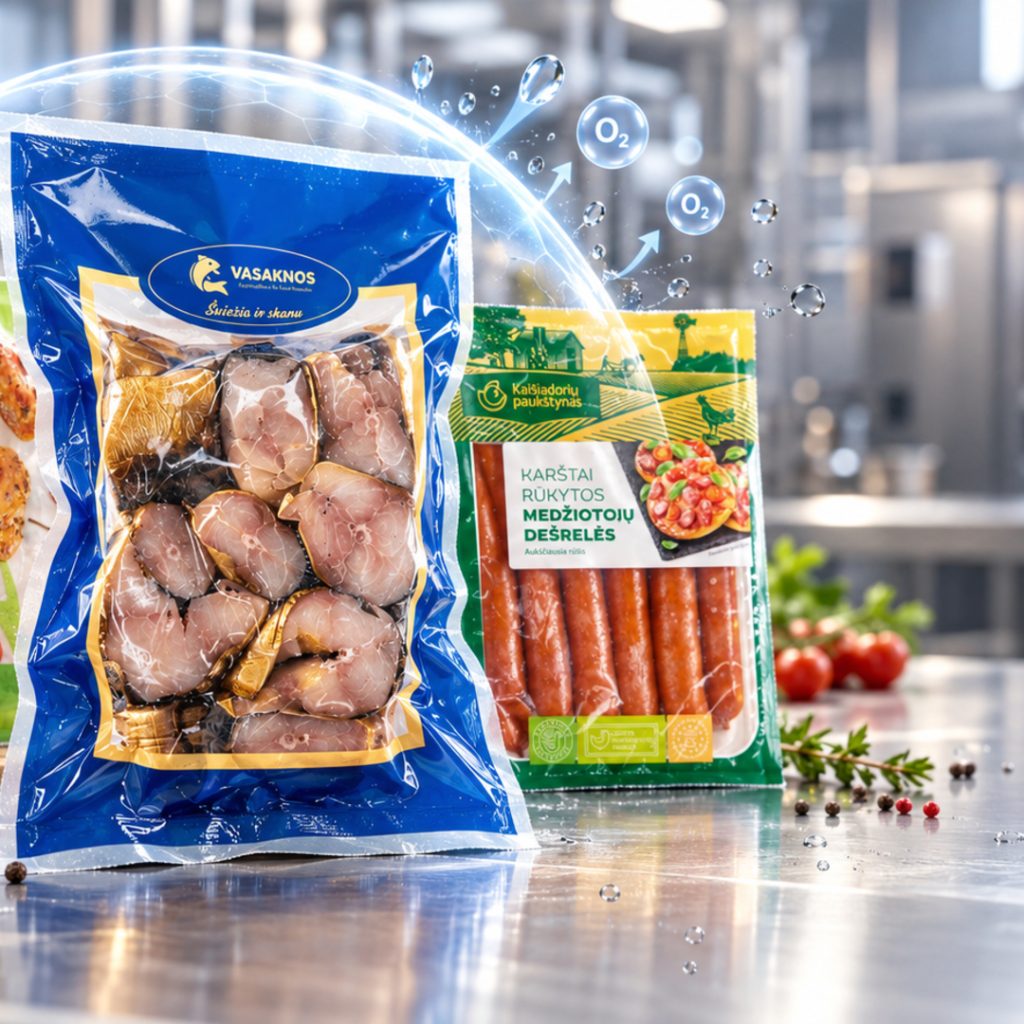
Note: The images used in this article are for illustrative purposes only.
OTR and WVTR: Two Important Indicators of Barrier Film Performance
To technically evaluate the properties of barrier packaging, two key indicators are important: OTR and WVTR.
OTR (Oxygen Transmission Rate)—the rate at which oxygen passes through the packaging material. It indicates how much oxygen can penetrate the packaging material over a specified period of time and under specific test conditions.
WVTR (Water Vapor Transmission Rate) describes the migration of water vapor in a similar manner.
A lower OTR value generally indicates a stronger oxygen barrier, while a lower WVTR value indicates a stronger water vapor barrier. When reviewing the data, these two values can only be properly compared if the test conditions are known, as the final result is influenced by temperature, relative humidity, material thickness, and the test method. Below is a table to help you better understand the values mentioned above and other parameters important for packaging.
Table No. 1. “Parameters, Functions, and Importance of Barrier Packaging”
| Parameter | What does it show? | Why is it important? |
| OTR | Oxygen migration through the packaging | Important for products sensitive to oxidation |
| WVTR | Water Vapor Migration | Important for the product’s moisture balance |
| Airtightness | The packaging’s ability to maintain a secure seal | Leaky packaging can negate the benefits of a good barrier |
| Mechanical resistance | Puncture and tear resistance | Helps maintain the integrity of the packaging during production and logistics |
When selecting barrier packaging, it is important to know what product needs to be protected, from what factors, and under what conditions.
Why is oxygen control in packaging important?
Oxygen that enters the packaging can accelerate oxidation processes, which may alter the aroma, taste, color, and other quality characteristics of sensitive food products, such as meat or fish. In multilayer solutions requiring a higher oxygen barrier, EVOH (ethylene-vinyl alcohol copolymer) can be used in multilayer solutions requiring a higher oxygen barrier. With its exceptionally good oxygen barrier properties, this solution is widely used in food packaging and is typically integrated as one of the layers in a multilayer structure.
The importance of EVOH extends beyond oxygen control. This material also exhibits good resistance to the migration of gases and aromatic compounds, so when used in multilayer food packaging, it can help preserve the product’s characteristic aroma and flavor.
Typically, in packaging production, this layer is used in medium- and high-barrier films intended for food products. At the same time, it is important to understand another key point: a higher barrier does not necessarily mean better packaging. Manufacturers determine the most suitable barrier level for your specific case based on the product, the packaging method, and the intended storage conditions.
Moisture Level in Packaging: Why Is It Important to Keep This in Mind?
Another function of barrier packaging—just as important as the oxygen barrier—is to control the migration of water vapor.
As a product loses moisture, its weight, texture, appearance, and other quality characteristics may change.
Conversely, there are often cases where it is necessary to protect the product from external moisture. For this reason, oxygen and moisture barriers should be evaluated together, and the packaging must help maintain the appropriate environment throughout the intended storage and transportation period for a specific product.
Interaction of MAP, Vacuum, and Barrier Properties in Packaging
During vacuum packaging, air is removed from the package, while in MAP technology, the product’s environment is replaced with a selected gas mixture. Although barrier properties are important in both cases, they are not the only factor. Even a film with very good oxygen barrier properties will not be able to perform its function properly if the package is improperly sealed or damaged.
In such cases, the entire system must be taken into account: the product, the film structure, the sealing, the packaging technology, storage conditions, and logistics. This principle is particularly important for MAP packaging, where the intended gas atmosphere must be maintained inside the package.
Why is not only the barrier but also the seal integrity of the packaging important? Because even a high-barrier film will not ensure the intended protection of the product if the final package is not properly sealed. Seal quality, mechanical resistance, and integrity during transport are all part of the barrier system. This functionality is particularly important for vacuum and MAP packaging, where the intended conditions must be maintained inside the package.
UMARAS barrier film solutions: from thermoforming to MAP
The choice of barrier packaging depends not only on the product but also on the packaging technology and equipment used. When selecting solutions for your business, it is important to understand that the film must not only provide the necessary oxygen and moisture barrier but also form properly, seal effectively, and perform reliably on a specific packaging line.
The UMARAS product range includes several barrier film solutions designed for the food industry:
- Mildflex®, a recyclable medium-barrier film, is a multilayer film designed for packaging perishable and long-shelf-life food products in a gas-flushed environment or under vacuum. It can be used as a thermoformable film and is also suitable for top sealing and FFS (Form-Fill-Seal) packaging lines.
- Medium- and high-barrier films for food products intended for vacuum and MAP (modified atmosphere) packaging. The product range includes various multilayer structures with PA and EVOH, as well as films suitable for pasteurization and sterilization. Depending on the selected variant, these films can be thermoformed, used for top sealing, or laminated with OPA, PET, PP, and other materials.
- LamLUX HB high-barrier film with EVOH is designed for further conversion. The structure, based on PE and EVOH, allows high-barrier properties to be integrated into the final packaging design according to the specific requirements of the product and packaging process.
- Laminated “Flow Pack” films and bags for vacuum and MAP packaging, the latter being particularly popular in the fish and seafood industries.
Below is a table illustrating the Umaras.eu range of barrier films
Table No. 2 “UMARAS Barrier Packaging Solutions, Applications, and Compatibility with Packaging Technology”
| Product | Primary Purpose | Appropriate packaging technology / line |
| Mildflex® Medium-Barrier Film | Perishable and extended-shelf-life food products | Thermoforming, FFS, top-seal, vacuum, and modified atmosphere packaging |
| Medium- and high-barrier films | Food products requiring a controlled barrier | Thermoforming, vacuum, and MAP packaging processes, top sealing |
| PA and EVOH containing structures | Products requiring a medium or high oxygen barrier | Vacuum and MAP packaging, thermoforming |
| LamLUX HB with EVOH | Production of high-barrier structures | Further conversion and lamination processes |
| Laminated “Flow Pack” film | Packaging of food and other products | “Flow Pack” packaging lines |
| Mildflex® and other vacuum bags | Meat, smoked or frozen fish and seafood, cheese, dairy products | Vacuum and MAP packaging |
To select the most suitable barrier film, in addition to mechanical properties, seal strength, and stable performance in packaging equipment, one should also evaluate the product’s sensitivity to oxygen and moisture, the expected shelf life, storage temperature, packaging technology, and the technical parameters of the packaging line being used.
It is worth noting that, in addition to the aspects listed above, additional features of UMARAS barrier films—such as PEEL (easy-peel) and ANTI-FOG (anti-fog)—can also be important for the functionality of the final package. The latter is particularly relevant in cases where good visibility of the packaged product is important, while the easy-peel function can contribute to a better end-user experience.
Barrier Film and Recycling
Modern packaging faces another requirement: balancing the product’s oxygen and moisture properties and protection with more efficient use of materials and recyclability. For businesses striving to contribute to environmental protection, UMARAS’s range of packaging solutions includes options that offer the necessary functional properties as well as improved recyclability (for example, Mildflex®).
How to Choose the Right Barrier Packaging?
To tailor the packaging to your business as effectively as possible, it’s best to start not with the question “which film is best?”, but with the specific needs of the product.
When making your selection, consider:
- the product’s sensitivity to oxygen and moisture;
- the required OTR and WVTR levels;
- the product’s storage temperature and conditions;
- the expected shelf life of the product;
- vacuum, MAP, or other packaging technologies;
- mechanical stresses during production and transportation;
- sealing requirements and the packaging equipment used;
- recyclability goals for the packaging.
By providing the information listed above to packaging manufacturers, you can be sure that the film structure and barrier levels will be optimally tailored to your solution.
Need help choosing barrier packaging?
Choosing the right barrier packaging solution can often seem extremely complicated, but with the help of UMARAS’s experienced specialists, this process can be smooth and reliable. Contact us via the contact information provided at Umaras.eu—after professionally assessing the requirements of your product and packaging process, we’ll help you select the right film structure and solutions for vacuum, MAP, or other packaging processes.